
What Is Professional Cleaning?
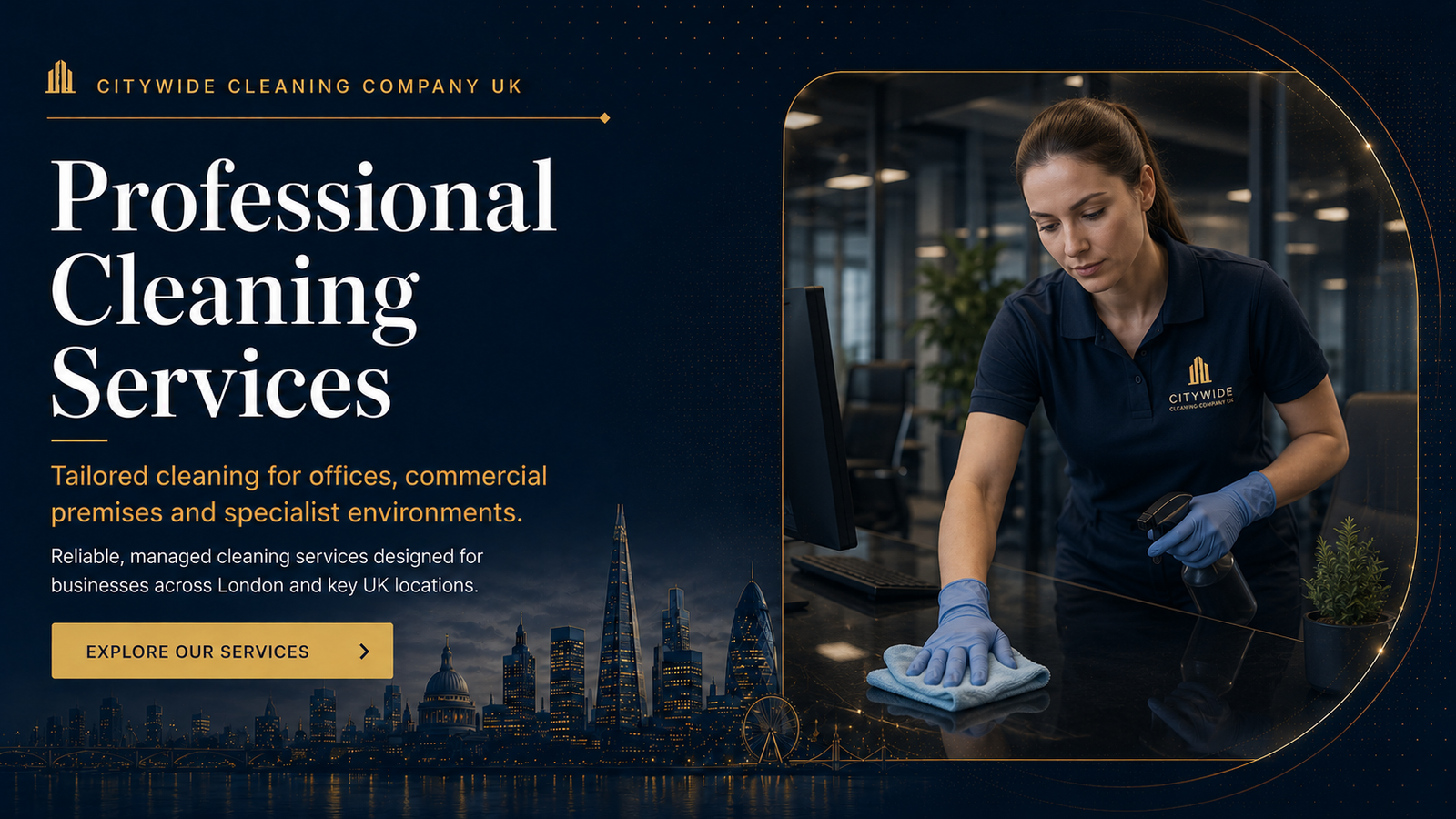
Professional Cleaning is a structured workplace cleaning service designed to keep offices hygienic, presentable and ready for employees, clients and visitors. Unlike casual cleaning, it is delivered through an agreed schedule, a written room-by-room specification, trained operatives, suitable equipment and ongoing quality management. Citywide Cleaning Company provides dependable office cleaning for small workplaces, corporate offices, professional practices, serviced offices, coworking spaces and multi-site organisations. Our service can cover desks, reception areas, meeting rooms, kitchens, washrooms, floors, internal glass, bins, recycling points and frequently touched surfaces. Cleaning can be arranged daily, several times per week, early in the morning, during the day, in the evening or outside normal business hours.
Businesses searching for office cleaning services, experienced office cleaners in London or reliable commercial cleaning services London need more than someone who simply attends the premises. They need a managed service with clear responsibilities, consistent standards and a reliable point of contact. Before your contract begins, we assess your workplace, discuss your priorities and prepare a cleaning plan around your occupancy, access arrangements, working hours and hygiene requirements. Your cleaners then work from the agreed specification rather than guesswork.
The result is a flexible professional office cleaning service that supports workplace presentation, reduces the burden on your internal team and gives you a clear process for monitoring standards, requesting changes and resolving concerns through responsive management throughout the life of your contract.
As an established commercial and office cleaning company in the UK, Citywide has supported commercial premises since 2004. That experience has shaped a structured approach focused on reliable staffing, clearly defined cleaning duties and responsive contract management.
When you appoint Citywide Cleaning Company, your office cleaning service can include:
✅ DBS-checked cleaning operatives
✅ COSHH-trained cleaning teams
✅ Written, site-specific cleaning specifications
✅ A named account manager
✅ Early morning, daytime and evening cleaning
✅ Same-day absence-cover arrangements
✅ Scheduled quality reviews
✅ Single-site and multi-site cleaning contracts
✅ A free site survey, normally available within 48 hours
✅ A written quotation, normally provided within 24 hours of the survey
Together, these service features give your business a clearer, more accountable cleaning arrangement from the initial site survey through to ongoing contract management.
Professional Cleaning Contracts Built Around Your Workplace
A professional office cleaning contract should make your workplace easier to manage. It should clearly explain what will be cleaned, when the cleaners will attend, which tasks are completed during each visit and who you should contact if something needs attention.
Citywide Cleaning Company creates a service plan around your actual workplace rather than placing every client into the same cleaning package. We consider:
- ✅ The size and layout of the office
- ✅ The number of employees using the premises
- ✅ Visitor and customer traffic
- ✅ Kitchen and washroom usage
- ✅ The number of meeting rooms and shared areas
- ✅ Floor and surface types
- ✅ Building access and security procedures
- ✅ Your preferred cleaning hours
- ✅ Restricted and confidential areas
- ✅ Waste and recycling arrangements
- ✅ Consumable requirements
- ✅ Existing cleaning problems
- ✅ Multi-site or property-management requirements
The result is a structured cleaning contract with clear responsibilities from the first visit.
Citywide Professional Cleaning Services
Citywide Cleaning Company provides flexible, professionally managed office cleaning for businesses across London and selected UK locations. Every regular contract begins with an assessment of the premises and a written cleaning specification. This gives the cleaning team a room-by-room task list and gives the client a clear standard against which the service can be reviewed.
Contracts can include daily cleaning, several visits per week, early morning cleaning, evening cleaning, daytime cleaning and out-of-hours support.
Depending on the agreed service, Citywide can also provide absence cover, account management, quality reviews, washroom hygiene, office deep cleaning, carpet cleaning and consumable support.
What Is Included in Professional Cleaning Services?
Every office cleaning specification is tailored to the premises. A small professional office may need focused cleaning two or three times per week. A larger corporate workplace may require daily cleaning, daytime washroom support and periodic specialist services.

The following areas are commonly included:
Desks and Workstations Cleaning:
Workstations collect dust, marks and general build-up through everyday use.
Your service can include:
- ✅ Cleaning accessible desk surfaces
- ✅ Dusting accessible office furniture
- ✅ Wiping telephones and shared equipment
- ✅ Cleaning chair arms
- ✅ Wiping cabinet exteriors
- ✅ Cleaning accessible shelving
- ✅ Removing marks from suitable surfaces
- ✅ Cleaning frequently touched points
Computer screens, personal items, confidential documents and specialist equipment will be handled according to the agreed site policy.
Where your business operates a clear-desk policy, this can be recorded within the cleaning specification.
Reception Areas and Entrances Cleaning:
Your reception area contributes to the first impression made on clients, applicants, contractors and visitors.
Reception cleaning can include:
- ✅ Reception desks
- ✅ Visitor seating
- ✅ Entrance doors
- ✅ Internal glass
- ✅ Display surfaces
- ✅ Entrance mats
- ✅ Floors and carpets
- ✅ Bins and waste points
- ✅ Door handles and touchpoints
Cleaning frequency can be increased for high-traffic, client-facing entrances.
Contact Us
Meeting Rooms and Boardrooms Cleaning:
Meeting rooms must remain presentable for internal discussions, client appointments, interviews and presentations.
Cleaning can include:
- ✅ Tables and chairs
- ✅ Accessible presentation surfaces
- ✅ Floors and carpets
- ✅ Internal glass
- ✅ Bins
- ✅ Door handles and touchpoints
- ✅ AV equipment exterior wiping
- ✅ Room resetting where agreed
The required frequency will depend on how often each room is used.
Office Kitchens and Breakout Areas Cleaning:
Shared kitchens and staff areas can quickly become untidy during the working day.
Your cleaning specification can include:
- ✅ Worktops
- ✅ Sinks and taps
- ✅ Appliance exteriors
- ✅ Cupboard fronts
- ✅ Tables and chairs
- ✅ Splashbacks
- ✅ Floors
- ✅ Bins and recycling points
- ✅ Breakout-area furniture
Internal fridge, microwave and cupboard cleaning can be added as a periodic or deep-cleaning task.
Office Washrooms Cleaning:
Washroom standards affect employee comfort, workplace hygiene and visitor confidence.
Routine washroom cleaning can include:
- ✅ Toilets and cubicles
- ✅ Urinals where applicable
- ✅ Basins and taps
- ✅ Mirrors
- ✅ Floors
- ✅ Fixtures and accessible surfaces
- ✅ Touchpoints
- ✅ Waste bins
- ✅ Agreed consumable checks
Offices requiring more extensive support can combine regular cleaning with our washroom hygiene services.
Floors and Carpets Cleaning:
The cleaning method will be selected according to the floor surfaces within your workplace.
Routine work can include:
- ✅ Carpet vacuuming
- ✅ Hard-floor mopping
- ✅ Entrance-floor cleaning
- ✅ Spot cleaning
- ✅ Edge and corner cleaning where agreed
- ✅ Cleaning around accessible office furniture
- ✅ Reporting visible damage or maintenance concerns
Routine vacuuming can also be supported by scheduled carpet cleaning for offices.
Internal Glass and Partitions Cleaning
Internal glass can quickly show fingerprints, dust and marks, particularly around meeting rooms and entrances. Cleaning can include:
- ✅ Glass doors
- ✅ Office partitions
- ✅ Meeting-room glass
- ✅ Reception glass
- ✅ Accessible internal windows
- ✅ Door vision panels
External window cleaning and high-level glass can be quoted separately where required.
Bins, Waste and Recycling Cleaning
Your service can include:
- ✅ Emptying desk-side bins
- ✅ Emptying kitchen and communal bins
- ✅ Replacing liners
- ✅ Consolidating waste
- ✅ Separating agreed recycling streams
- ✅ Moving waste to designated collection points
- ✅ Cleaning accessible bin exteriors
The location of collection points and the handling of confidential waste should be agreed before the contract starts.
High-Touch Surfaces Cleaning
Busy workplaces may require additional attention around shared touchpoints.
These can include:
- ✅ Door handles
- ✅ Push plates
- ✅ Light switches
- ✅ Handrails
- ✅ Lift buttons
- ✅ Shared telephones
- ✅ Kitchen handles
- ✅ Meeting-room touchpoints
- ✅ Shared office equipment
The frequency can be adjusted to suit the level of workplace use.
Professional Office Cleaning Schedules That Fit Your Business
The right cleaning frequency depends on occupancy, footfall, office size, washroom demand and the standard your business wants to maintain.
| Schedule | Best Suited To | Typical Approach |
| Daily office cleaning | Busy offices, corporate premises and client-facing workplaces | Workstations, meeting rooms, kitchens, washrooms, floors and bins cleaned throughout the working week |
| Several visits per week | Small and medium-sized offices with moderate occupancy | Core areas cleaned during every visit, with kitchens and washrooms prioritised |
| Weekly office cleaning | Smaller offices with limited footfall | A fuller clean during each scheduled visit, based on the size and facilities |
| Early morning cleaning | Businesses that want cleaning completed before employees arrive | The office is prepared before the main working day begins |
| Evening cleaning | Offices that prefer cleaning after employees leave | More detailed work completed with access, alarm and locking procedures agreed in advance |
| Daytime cleaning | Larger offices and managed workplaces | Visible support for washrooms, kitchens, reception areas, waste and spills |
| Out-of-hours cleaning | Premises where cleaning during operations would be disruptive | Cleaning arranged around opening hours and building-access requirements |
| Weekend cleaning | Offices with restricted weekday access or periodic requirements | Routine or specialist cleaning completed outside the normal working week |
Choosing a schedule based only on the lowest initial cost can create larger problems later.
When cleaning frequency is too low, kitchens, washrooms and high-traffic areas deteriorate more quickly. The business may then face staff complaints, repeated emergency cleaning or unplanned deep-cleaning costs. The right schedule is the one that reflects how the workplace is actually used.
Who We Provide Office Cleaning For
Our cleaning contracts can be adapted to a wide range of professional workplaces.
We support:
- ✅ Small and medium-sized offices
- ✅ Corporate headquarters
- ✅ Legal practices
- ✅ Accountancy firms
- ✅ Financial and insurance offices
- ✅ Recruitment and consultancy companies
- ✅ Technology businesses
- ✅ Creative and media agencies
- ✅ Property management offices
- ✅ Estate agency offices
- ✅ Charities and not-for-profit organisations
- ✅ Administrative workplaces
- ✅ Serviced offices
- ✅ Coworking spaces
- ✅ Multi-tenant office buildings
- ✅ Managed workplaces
- ✅ Multi-site organisations
Businesses responsible for flexible offices, serviced offices and shared environments can also explore our managed workspace cleaning services.
From First Enquiry to First Clean.
A structured setup helps prevent misunderstandings after the service begins.
1. Initial Consultation
We discuss your office, current cleaning arrangements, preferred schedule and main concerns.
The initial conversation may cover:
- ✅ Office size
- ✅ Number of employees
- ✅ Current cleaning hours
- ✅ Preferred attendance times
- ✅ Kitchens and washrooms
- ✅ Floor types
- ✅ Building access
- ✅ Existing service concerns
- ✅ Required start date
- ✅ Additional services
There is no obligation to proceed.
2. Free Professional Cleaning Site Survey
Where appropriate, we visit the premises to understand the actual cleaning requirement.
The survey can include:
- ✅ Workstations
- ✅ Receptions
- ✅ Meeting rooms
- ✅ Kitchens
- ✅ Washrooms
- ✅ Floors
- ✅ Internal glass
- ✅ Waste points
- ✅ Storage facilities
- ✅ Access arrangements
- ✅ Security procedures
Site surveys are normally arranged within 48 hours, subject to location and appointment availability.
3. Written Cleaning Specification
We prepare a room-by-room cleaning specification showing:
- ✅ The areas included
- ✅ The tasks required
- ✅ The frequency of each task
- ✅ Cleaning days
- ✅ Attendance times
- ✅ Periodic duties
- ✅ Equipment requirements
- ✅ Consumable arrangements
- ✅ Site-specific instructions
This becomes the working document for the cleaning contract.
4. Written Quotation
Your quotation is based on the actual work required rather than a generic package.
It may include:
- ✅ Cleaning labour
- ✅ Attendance frequency
- ✅ Cleaning products
- ✅ Equipment
- ✅ Supervision
- ✅ Account management
- ✅ Periodic services
- ✅ Consumables
- ✅ Specialist requirements
Written quotations are normally provided within 24 hours of completing the site survey.
5. Cleaner Allocation and Induction
Suitable operatives are selected according to the location, schedule and requirements of the contract.
Before work begins, they are briefed on:
- ✅ The cleaning specification
- ✅ Building access
- ✅ Alarm instructions
- ✅ Restricted areas
- ✅ Health and safety
- ✅ Confidentiality
- ✅ Waste handling
- ✅ Reporting procedures
- ✅ Site-specific expectations
6. Service Mobilisation
Your service begins on the agreed date.
Most straightforward contracts can mobilise within one week of signing, subject to staffing, access and operational requirements.
Where the previous cleaning standard has declined, we may recommend an initial office deep clean before regular cleaning begins.
7. Ongoing Account Management
Your named account manager remains available after the contract starts.
The service can be reviewed when:
- ✅ Employee numbers increase
- ✅ Office attendance changes
- ✅ New rooms are opened
- ✅ The workplace is reconfigured
- ✅ Washroom use increases
- ✅ Your opening hours change
- ✅ Additional sites are added
- ✅ Periodic cleaning is required
Cleaning plans should develop as the business develops.
Why Businesses Choose Citywide Cleaning Company
Commercial Cleaning Experience Since 2004
Citywide Cleaning Company has supported commercial premises since 2004.
This experience has shown that the most reliable cleaning contracts share three characteristics:
- ✅ The work is clearly specified
- ✅ The cleaning team understands the premises
- ✅ Problems are communicated and corrected promptly
Our service structure is designed around these principles.
Specification-Led Cleaning
Cleaners work from an agreed scope instead of relying on memory or guesswork.
This helps protect standards when:
- ✅ A relief cleaner attends
- ✅ The office layout changes
- ✅ New tasks are introduced
- ✅ A complaint needs to be reviewed
- ✅ The contract is reassessed
Consistent Cleaning Teams
Where possible, we maintain a regular cleaner or cleaning team at each workplace.
Familiar operatives learn:
- ✅ The office layout
- ✅ Building-access procedures
- ✅ Priority areas
- ✅ Waste locations
- ✅ Restricted rooms
- ✅ Client preferences
- ✅ The expected standard
Consistency helps the cleaning team become more efficient and accountable over time.
Managed Absence Cover
Sickness and holidays should not result in silent missed visits.
Our operations team manages cover arrangements and communicates any necessary service changes. Where same-day cover is required, we work to provide a suitable replacement as quickly as operationally possible.
Clear Communication
Clients should know who to contact and what will happen after a concern is reported.
Your named account manager provides a direct route for:
- ✅ Reporting missed tasks
- ✅ Requesting schedule changes
- ✅ Adding services
- ✅ Reviewing quality
- ✅ Updating the specification
- ✅ Discussing staffing concerns
Support for Multi-Site Businesses
Businesses with several offices can discuss a coordinated cleaning arrangement.
This can include:
- ✅ One named point of contact
- ✅ A separate specification for each site
- ✅ Shared management standards
- ✅ Coordinated mobilisation
- ✅ Centralised communication
- ✅ Site-specific quality reviews
- ✅ Consolidated administration where agreed
Each building remains different, but the management and accountability structure can remain consistent.
Quality Assurance, Health and Safety
Professional office cleaning must be delivered safely and with proper regard for employees, visitors and cleaning operatives.
Depending on the premises, the contract may include:
- ✅ Site-specific risk assessments
- ✅ COSHH information
- ✅ Product safety documentation
- ✅ Colour-coded cleaning materials
- ✅ Suitable personal protective equipment
- ✅ Safe product storage
- ✅ Wet-floor signage
- ✅ Manual-handling procedures
- ✅ Building inductions
- ✅ Accident and incident reporting
- ✅ Restricted-area instructions
Quality-management measures may include:
- ✅ Cleaning checklists
- ✅ Site inspections
- ✅ Account-management reviews
- ✅ Written quality findings
- ✅ Corrective actions
- ✅ Cleaner re-briefing
- ✅ Specification updates
- ✅ Client feedback
Your existing contractor requirements and building-management rules can be reviewed before the service starts.
Security and Confidentiality
Office cleaners may work before employees arrive or after they leave.
Security procedures should therefore form part of the cleaning plan.
Your site instructions can cover:
- ✅ Keys and access cards
- ✅ Alarm setting and deactivation
- ✅ Signing-in procedures
- ✅ Secure entry and exit points
- ✅ Restricted rooms
- ✅ Confidential documents
- ✅ Clear-desk policies
- ✅ Data-sensitive areas
- ✅ Doors and windows
- ✅ Escalation contacts
- ✅ Reporting suspicious or unusual conditions
Cleaning operatives should not move confidential papers, access unauthorised rooms or interfere with specialist equipment unless the task has been specifically agreed.
This is especially important for legal practices, financial organisations, healthcare administration offices and other professional environments handling sensitive information.
Cleaning Products, Equipment and Consumables
Your quotation will explain which products, equipment and consumables are included.
Depending on the contract, Citywide can supply or manage:
- ✅ General cleaning products
- ✅ Colour-coded cloths and materials
- ✅ Mops and buckets
- ✅ Vacuum cleaners
- ✅ Floor-care equipment
- ✅ Bin liners
- ✅ Hand soap
- ✅ Toilet tissue
- ✅ Paper towels
- ✅ Washroom consumables
- ✅ Specialist products where required
The final arrangement will depend on storage space, building rules, service requirements and your preferred procurement method.
Businesses with environmental or procurement requirements can also discuss our eco-friendly cleaning options.
Recognised Among the Best Office Cleaning Companies in London
Citywide Cleaning Company is proud to be recognised among the best office cleaning companies in London. Since 2004, we have supported offices, professional practices, managed workplaces and commercial premises with cleaning contracts built around reliability, clear specifications and responsive account management.
Our position as a trusted top office cleaning company in London is supported by the practical standards we apply to every contract, not simply by marketing claims.
Businesses and office managers choose Citywide because we provide:
✅ DBS-checked and COSHH-trained cleaning operatives
✅ Written, site-specific cleaning specifications
✅ Consistent cleaning teams wherever possible
✅ A named account manager
✅ Flexible early morning, daytime and evening schedules
✅ Planned absence-cover arrangements
✅ Regular quality reviews
✅ Support for single-site and multi-site offices
✅ Clear quotations based on an assessment of the premises
Being considered among London’s leading office cleaning providers reflects our long-standing commitment to dependable staffing, accountable service management and cleaning plans designed around the way each workplace operates.
For businesses comparing providers, our guide explains what to look for when assessing office cleaning companies, including experience, staffing arrangements, quality control, service flexibility and contract transparency.
How Office Cleaning Prices Are Calculated.
A professional cleaning quotation should reflect the work required at your actual premises.
The main pricing factors include:
- ✅ Office size and layout
- ✅ Number of floors
- ✅ Employee numbers
- ✅ Visitor traffic
- ✅ Cleaning frequency
- ✅ Required cleaning hours
- ✅ Attendance times
- ✅ Number of kitchens
- ✅ Number of washrooms
- ✅ Floor types
- ✅ Building access
- ✅ Security procedures
- ✅ Products and equipment
- ✅ Consumables
- ✅ Periodic cleaning
- ✅ Location
- ✅ Multi-site requirements
An open-plan office may take less time to clean than a smaller workplace divided into numerous rooms, kitchens and washrooms.
A lightly occupied hybrid office may also need a different schedule from a fully occupied workplace operating five or seven days per week.
The site survey allows us to calculate the labour and resources required before presenting the written quotation.
London businesses can read our detailed guide to office cleaning costs in London.
Professional Cleaning Services in London
London is Citywide Cleaning Company’s principal service area. Our dedicated Office Cleaning London hub explains our services across Central London, the City of London, Canary Wharf and wider Greater London business districts.
London offices often present specific operational challenges, including:
- ✅ Restricted access hours
- ✅ Security-desk procedures
- ✅ Shared lifts and loading areas
- ✅ Landlord and building-management rules
- ✅ Limited storage
- ✅ Congestion and parking restrictions
- ✅ Multi-floor workplaces
- ✅ Shared communal facilities
- ✅ Early morning and evening access
Our London cleaning plans are structured around these practical requirements.
Businesses can use the London hub to review local coverage, service options, district pages and London-specific pricing considerations.
Explore Professional Cleaning in London
Office Cleaning Across Selected UK CitiesCitywide also supports enquiries across selected UK commercial centres.
Office Cleaning Manchester
Our office cleaning services in Manchester support offices, managed workplaces and commercial premises across Manchester City Centre and surrounding business districts.
Office Cleaning Birmingham
Our office cleaning services in Birmingham are available for professional workplaces and commercial premises across selected parts of Birmingham and the West Midlands.
Office Cleaning Liverpool
Our office cleaning services in Liverpool support professional firms, managed offices and commercial workplaces across selected Liverpool locations.
Office Cleaning Leeds
Our office cleaning services in Leeds support offices and commercial premises across Leeds and selected West Yorkshire business areas.
For another location, provide the postcode, required schedule and estimated service hours so our team can confirm availability.
Thinking of Changing Your Cleaning Company?
Many businesses already have a cleaning provider when they contact Citywide.
They are usually considering a change because the current service has become unreliable or difficult to manage.
Common problems include:
- ✅ Missed cleaning visits
- ✅ No communication about absence
- ✅ Constant changes of cleaner
- ✅ Poor kitchen standards
- ✅ Untidy washrooms
- ✅ Unemptied bins
- ✅ Dusty workstations
- ✅ Incomplete floor cleaning
- ✅ No written specification
- ✅ Complaints going unanswered
- ✅ No regular quality checks
- ✅ Unclear responsibility for correcting problems
How We Manage the Transition
A planned takeover can reduce disruption and prevent gaps in cleaning.
The process may include:
- ✅ Reviewing the existing arrangement
- ✅ Surveying the premises
- ✅ Identifying missed and high-priority areas
- ✅ Preparing a new cleaning specification
- ✅ Confirming keys, access and alarm procedures
- ✅ Agreeing the mobilisation date
- ✅ Planning absence cover
- ✅ Arranging an initial deep clean where required
- ✅ Reviewing the first weeks of service
Where the existing cleaning staff may be affected by a change of contractor, the relevant employment and mobilisation requirements should be reviewed before the transfer date.
Comprehensive Professional Cleaning Services
Regular office cleaning can be combined with related specialist services.
Office Deep Cleaning
Deep cleaning provides more detailed attention to areas that are not included during every routine visit.
It can include:
- ✅ Kitchen deep cleaning
- ✅ Washroom deep cleaning
- ✅ Detailed surface cleaning
- ✅ High-level dusting
- ✅ Floor edges and corners
- ✅ Internal fixtures
- ✅ Cleaning behind accessible furniture
- ✅ Initial cleaning before a new contract
Our professional deep cleaning services can be arranged as a one-off service or as part of a planned programme.
Office Carpet Cleaning
Scheduled carpet cleaning can help address marks, tracked-in dirt and deeper build-up that routine vacuuming cannot remove.
Explore our carpet cleaning services for offices.
Washroom Hygiene Services
A dedicated washroom service can provide additional support for busy offices, shared buildings and high-occupancy workplaces.
View our commercial washroom hygiene services.
Managed Workspace Cleaning
Serviced offices and coworking environments require flexible cleaning because numerous businesses share meeting rooms, kitchens, washrooms and communal facilities.
Our managed workspace cleaning services can be planned around occupancy, member access and operating hours.
What You Need to Know Before Choosing a Cleaning Contract
Every Contract Should Start With a Written Specification
Your cleaners should work from a room-by-room task list, not guesswork. A written specification helps prevent standards from drifting and gives everyone a clear reference point.
✅ DBS Checks Should Be Completed Before Placement
Cleaning operatives may work outside normal business hours or enter areas containing sensitive information. DBS checks and site-specific security instructions help reduce avoidable risks.
✅ Absence Cover Should Be Planned Before It Is Needed
Sickness and holidays are predictable parts of any staffed service. The contract should explain how cover will be arranged and how the client will be informed.
✅ The Cleaning Schedule Must Match Actual Footfall
A schedule chosen only because it is the cheapest option may not be enough for busy washrooms, shared kitchens or heavily used meeting areas.
✅ You Should Have One Clear Point of Contact
A named account manager makes it easier to report concerns, request changes and review the service without repeating the same information to different people.
✅ The Quote Should Follow a Proper Review of the Premises
A reliable quotation should reflect the layout, occupancy, facilities, access requirements and cleaning frequency. Square footage alone rarely provides the full picture.
Frequently Asked Questions
What is included in a professional office cleaning contract?
A professional office cleaning contract can include workstations, meeting rooms, reception areas, kitchens, washrooms, floors, bins, internal glass, touchpoints and shared areas.
The exact tasks, cleaning days and frequencies are recorded in a written specification before the regular service begins.
How often should an office be cleaned?
The correct frequency depends on the office size, number of employees, visitor traffic, kitchen usage, washroom usage and required cleaning standard.
Busy workplaces usually require daily cleaning. Smaller or moderately occupied offices may need two or three visits per week. A lightly used office may be suitable for a weekly service.
The site survey helps determine a practical schedule.
Can you clean outside normal business hours?
Yes. Office cleaning can be arranged early in the morning, during the day, in the evening or outside normal working hours.
Availability will depend on the location, required service hours and building-access arrangements.
Are your cleaning operatives DBS-checked?
Yes. Cleaning operatives are DBS-checked before placement on client sites.
They are also briefed on the premises, cleaning specification, access procedures and relevant security requirements.
Are your cleaners trained in COSHH procedures?
Cleaning operatives receive relevant COSHH training for the safe handling and use of cleaning products.
Product information and site-specific requirements can be reviewed during mobilisation.
What happens if our regular cleaner is sick?
Citywide maintains absence-cover arrangements for sickness, holidays and unexpected non-attendance.
The operations team works to arrange suitable same-day cover where required and operationally possible.
Will we have the same cleaner each time?
Where possible, a regular cleaner or cleaning team is allocated to the workplace.
Consistency helps operatives understand the premises and expected standards. Relief cover may be provided during sickness, holidays or unexpected absence.
Do you provide the cleaning products and equipment?
Products and equipment can be supplied as part of the contract where agreed.
Your written quotation will confirm what Citywide will provide and whether your business is responsible for any storage, equipment or specialist supplies.
Can you supply washroom consumables?
Consumables can be included within the service where required.
These may include toilet tissue, hand soap, paper towels and bin liners. Products and ordering arrangements will be confirmed in the quotation.
Can you manage several offices under one contract?
Yes. Multi-site cleaning can be discussed where the locations and required service hours fall within our operating coverage.
Each location can have its own specification while account management and reporting are coordinated centrally.
Do you provide one-off office deep cleaning?
Yes. Office deep cleaning can be arranged before a new contract, following a refurbishment, after a decline in standards or as part of a periodic cleaning programme.
How quickly can the cleaning service start?
Most straightforward contracts can mobilise within one week of signing.
The exact timescale will depend on the location, staffing requirements, access arrangements and scope of work.
How quickly will we receive a quotation?
Written quotations are normally provided within 24 hours of the site survey, provided all necessary information is available.
What contract length and notice period do you require?
Contract length and notice requirements are explained before you sign.
The terms will reflect the service scope, mobilisation requirements and commercial agreement. They will be set out clearly in the written contract.
Do you provide office cleaning in London?
Yes. London is our principal office-cleaning service area.
Visit our Office Cleaning London hub for information about local coverage, London business districts, service schedules and quotation arrangements.
Office Cleaning Guides and ResourcesBusinesses reviewing their cleaning requirements may also find these resources useful:
- How Much Does Office Cleaning Cost in London? – Understand the main factors affecting London office-cleaning quotations and contract costs.
- How to Find a Good Cleaning Company in London – A practical guide to assessing cleaning providers, service standards and contract arrangements.
- 8 Steps to Take When Looking for a Cleaning Company – A useful checklist for businesses comparing prospective cleaning contractors.
- How Office Cleaning Can Improve Your Business – Explore how cleaning standards can affect workplace presentation, employees and visitors.
Request Your Free Office Cleaning QuoteTell us about your workplace, current cleaning arrangements and required schedule.
Citywide Cleaning Company will review your needs and recommend a practical service based on your premises.
Your office cleaning contract can include:
- ✅ A free site survey
- ✅ A written room-by-room specification
- ✅ DBS-checked cleaning operatives
- ✅ COSHH-trained cleaning teams
- ✅ A named account manager
- ✅ Daily or selected-day cleaning
- ✅ Early morning, daytime or evening attendance
- ✅ Absence-cover arrangements
- ✅ Scheduled quality reviews
- ✅ Deep cleaning and carpet-cleaning support
- ✅ Washroom and consumable services
- ✅ Multi-site cleaning management
Provide your office location, approximate size, number of employees, preferred cleaning days and proposed start date.