
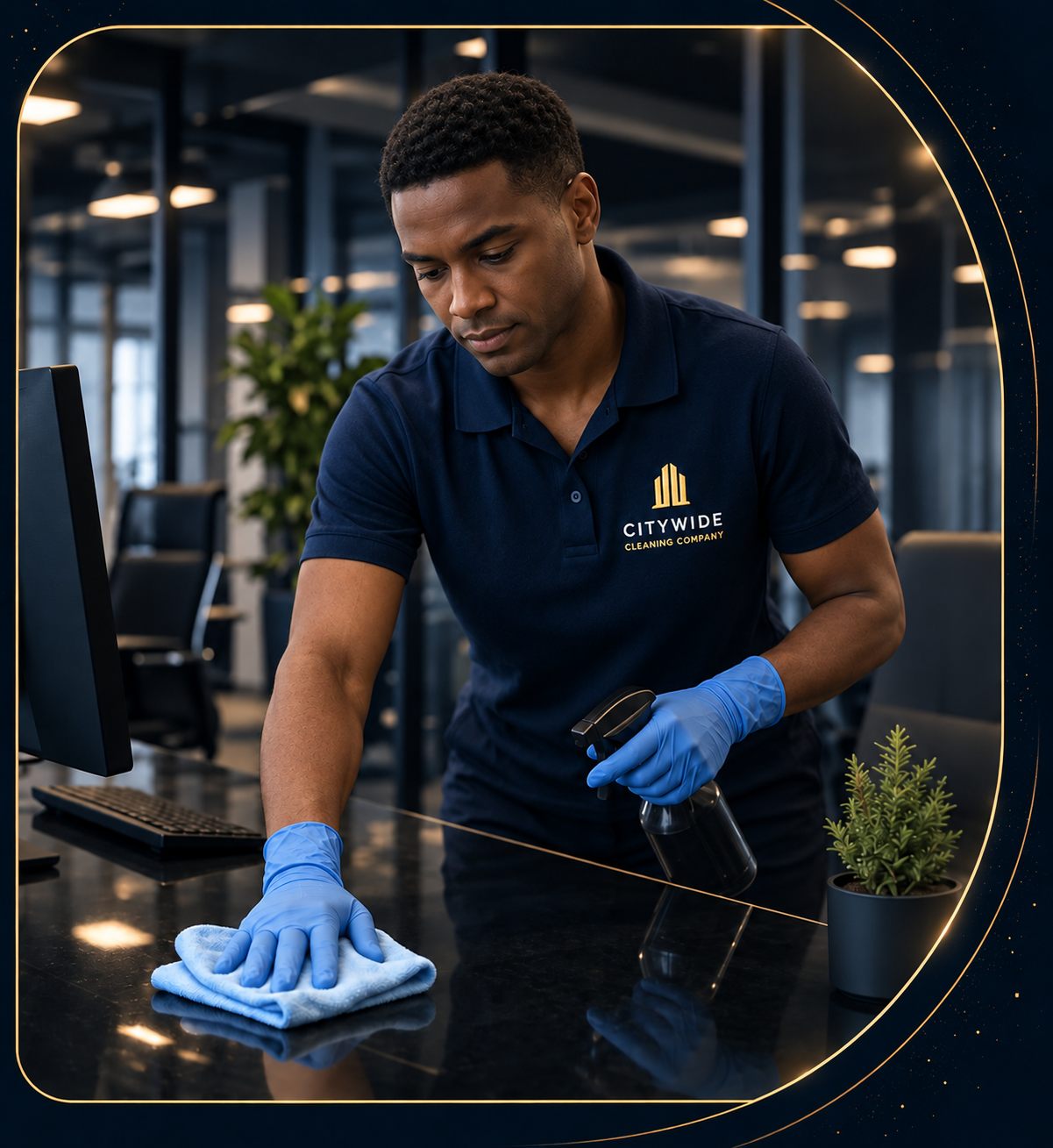
Commercial Cleaning in Mayfair, London: The Standards Luxury Estates & Boutiques Expect
In Mayfair, cleanliness is part of the experience. This guide explains the standard luxury boutiques, private estates and prestigious commercial properties should expect from a professional cleaning contractor.
Premium cleaning is judged by the finish, not by the checklist
Mayfair is home to luxury retailers, galleries, private residences, members' clubs, professional firms and prestigious customer-facing properties. In these environments, a small presentation failure can become highly visible.
A fingerprint on polished glass, dust around a brass fitting, a streak across marble, an untidy washroom or a cleaner working through the wrong entrance can undermine an otherwise exceptional property.
Luxury-standard commercial cleaning in Mayfair should consistently deliver six things: presentation, discretion, specialist surface care, security awareness, consistency and accountability. The property should not merely be technically clean. It should be ready for clients, customers, residents and inspection.
What makes commercial cleaning in Mayfair different?
Mayfair properties often combine luxury finishes, high-value merchandise, private or security-sensitive areas and exacting presentation standards. The cleaning contractor must therefore manage not only visible cleanliness, but also discretion, specialist surface care, access control and the overall customer or resident experience.
How often should Mayfair premises be cleaned?
Busy customer-facing premises usually benefit from daily cleaning, supported by weekly detailed tasks and planned periodic work. Luxury retail, hospitality-style environments and heavily used buildings may also require daytime presentation checks for entrances, washrooms, glass and high-touch areas.
What should you look for in a Mayfair cleaning company?
Look for a contractor that provides a site-specific specification, professionally presented and appropriately vetted operatives, reliable absence cover, specialist surface knowledge, secure access procedures, documented quality control and clear management accountability.
This is a supporting buyer guide, not a generic location landing page. It focuses on the operating standards that matter in premium Mayfair environments, while broader service information is available through Citywide's managed commercial cleaning services across London.
Six standards that separate premium cleaning from routine cleaning
The basic task list is rarely the difference. Most contractors can vacuum a carpet, clean a washroom or empty a bin. The difference is how carefully the work is performed, how consistently the finished result is checked, and how well the cleaning team understands the environment.
Presentation
Entrances, glass, floors, washrooms and customer-facing details should look prepared for the next visitor, not merely serviced.
Discretion
Operatives should understand how to work around clients, residents, merchandise, confidential material and sensitive conversations.
Surface Care
Marble, brass, timber, glass, specialist stone, luxury carpets and decorative finishes require material-appropriate methods.
Security
Keys, access cards, alarms, restricted rooms, service entrances and locking procedures should be clearly controlled.
Consistency
The Friday standard should match the Monday standard. Premium cleaning cannot depend on whether the regular cleaner happens to be present.
Accountability
Problems should be identified, recorded and corrected by the contractor before the client becomes the de facto cleaning supervisor.
Luxury properties need an inspection-ready finish
A property can be technically clean while still looking below standard. A floor may have been mopped but retain streaks. Glass may have been wiped but still show fingerprints around handles. A washroom may have been serviced but mirrors and chrome fittings may remain dull.
What should look flawless?
- Polished entrances and reception areas
- Glass doors, mirrors and partitions
- Stone, timber and premium flooring
- Brass, chrome and decorative fittings
- High-specification washrooms
- Customer lounges and fitting rooms
What requires specialist judgement?
- Natural stone that may react to acidic products
- Timber finishes sensitive to excessive moisture
- Premium carpets requiring controlled stain treatment
- Decorative metals vulnerable to abrasive pads
- Glass exposed to strong architectural or retail lighting
- Specialist coatings with manufacturer-specific guidance
The cleaning method should follow the material, not the other way around. A product that works well in a back-of-house environment can damage a luxury finish in seconds. This is one reason experienced commercial cleaning teams serving Central London should identify sensitive surfaces during mobilisation.
Luxury boutiques and private estates need different operating disciplines
For boutiques, cleaning is part of the brand experience
Customers experience the environment before they inspect the product. Entrance doors, display windows, mirrors, fitting rooms, polished floors and counters must therefore support the brand's visual standard.
- Entrance and threshold checked before opening
- Mirrors and internal glass left streak-free
- Fitting rooms inspected at close range
- Display areas dust-free without disturbing merchandising
- Washrooms presented to the same standard as the sales floor
For estates, trust and continuity become part of the service
The contractor may work around valuable furniture, artwork, private belongings and sensitive information. The client should always know who is attending, who supervises them and how access is controlled.
- Regular operatives wherever practical
- Clear vetting and replacement procedures
- Restricted-area instructions
- Controlled key and access-card handling
- Incident escalation without delay
For properties that need wider geographic support, Citywide can coordinate professional cleaning coverage across London while keeping each property's specification site-specific.
The cleaner should never become the most visible part of the environment
Premium cleaning is not only about technical ability. Operatives may work around clients, residents, senior executives, confidential documents, high-value merchandise or security-sensitive areas. Their conduct becomes part of the property experience.
Professional Conduct
Uniform, personal presentation, appropriate conversation and an understanding of when to remain unobtrusive all matter.
Access Discipline
Service entrances, lifts, restricted rooms and approved working routes should be agreed before cleaning begins.
Confidentiality
Private documents, customer information, personal belongings and sensitive activities should never be photographed, discussed or disturbed.
Security responsibilities should be written down
- Who opens and closes the property?
- Who may hold keys or access cards?
- Which areas are restricted?
- What happens if an alarm activates?
- Who is called if a door cannot be secured?
Never rely on assumptions
A cleaner should never leave a security problem unresolved because the responsibility was unclear. Alarm, access and locking procedures should be part of the mobilisation brief, especially where the service runs outside normal trading hours.
Match the cleaning schedule to how the property is actually used
Main cleaning without customer disruption
Vacuuming, floor care, waste removal and detailed cleaning are often better completed before opening or after closing, when operatives can work efficiently and surfaces have time to dry.
Maintain presentation between main cleans
Busy properties may require daytime checks for entrances, washrooms, glass, bins and other high-visibility areas. This is presentation maintenance, not a substitute for the main clean.
Give heavily used surfaces their own frequency
Door handles, lift buttons, handrails, reception counters, washroom fixtures and touchscreens may need more attention than the general schedule.
Visitors often judge the cleanliness of the whole property by the washrooms. Mirrors, chrome, basins, cubicle doors, dispensers, floors, bins, sanitary units, consumables and odour control should therefore be treated as a complete presentation system, not as isolated tasks.
Where a property needs both scheduled cleaning and presentation support, a contractor with managed cleaning capability across the capital can structure the service around trading hours rather than forcing the property into a standard shift pattern.
The client should not have to become the cleaning supervisor
One of the most common service failures is gradual decline. The first weeks are strong, then small details begin to slip. A premium contract needs a system that detects deterioration before the client repeatedly has to report it.
Inspect
Supervisor checks should compare the finished property against the written specification, not simply confirm attendance.
Record
Missed tasks, recurring issues and property changes should be documented so that patterns are visible.
Correct
Problems should trigger clear corrective action, including retraining, schedule changes, added supervision or staffing adjustments.
How do you know whether a premium cleaning contract is being managed properly? Look for documented inspections, named accountability, absence cover, issue tracking and evidence that recurring problems are corrected rather than repeatedly acknowledged.
A Mayfair specification should be built around the property, not copied from another contract
A site survey should identify building size, customer traffic, operating hours, sensitive surfaces, washrooms, kitchens, security restrictions, waste volumes, back-of-house areas and periodic requirements. The schedule can then separate tasks by frequency.
| Frequency | Typical Focus | Why It Matters |
|---|---|---|
| Daily | Floors, washrooms, bins, kitchens, entrances, touch points, visible glass | Protects the everyday customer and staff experience |
| Weekly | Detailed dusting, skirting edges, furniture detail, lower-use areas | Stops small presentation failures building up |
| Periodic | Carpet extraction, floor treatment, upholstery, high-level cleaning, specialist glass | Protects materials and restores areas that daily cleaning cannot fully maintain |
Do not only state what the cleaner should do. Define the finished standard the client should see afterwards. Citywide uses this principle when building tailored cleaning programmes for London properties.
Seven signs a cleaning contractor may not be ready for a prestigious Mayfair property
Not every cleaning provider is equipped for luxury, customer-facing or security-sensitive premises. A Mayfair contractor should demonstrate how it will protect the property standard before mobilisation, not after the first complaint. These warning signs should trigger more questions before an appointment is made.
Quoting without understanding the premises
A reliable contractor should understand the site, surfaces, operating hours and access requirements before assuming how many labour hours are needed.
A proposal that simply says “general cleaning”
Vague wording creates vague accountability. The specification should make clear which areas, frequencies and standards are included.
No clear explanation of supervision
If the provider cannot explain who checks the cleaner's work, the client may eventually inherit that responsibility.
No replacement or absence-cover process
A premium service needs continuity. Ask exactly what happens when the regular operative is ill, on leave or unavailable.
Every surface is treated the same
Luxury materials need material-specific methods. One chemical, cloth or pad is not suitable for every finish.
The conversation is almost entirely about price
A low hourly rate has little value if too few hours are allocated, tasks are missed or management time is spent chasing the service.
Communication is already slow before mobilisation
Responsiveness rarely improves after the contract is signed. Slow quoting, unclear answers and repeated chasing are useful early indicators.
No interest in security or access procedures
A contractor serving Mayfair properties should ask about keys, alarms, restricted areas, service entrances and emergency contacts before deployment.
Choose the contractor that can explain how the standard will be delivered, measured and recovered when something goes wrong. That is more useful than a generic promise of “high-quality cleaning.”
What determines the cost of commercial cleaning in Mayfair?
There is no meaningful single price for every property. Two buildings of similar size can require very different labour allocations because one may contain more washrooms, luxury finishes, customer traffic, security procedures or periodic work.
The hourly rate is only half the equation
If one contractor allocates 20 hours a week and another quotes 12, the second proposal may look cheaper while expecting the cleaner to complete substantially more work per hour. The client eventually pays through missed tasks, complaints and management time.
Ask whether the resources match the standard
The stronger comparison is not “Who has the lowest rate?” It is “Which provider has allocated the right people, hours, supervision and specialist support to maintain the standard we expect?”
Businesses comparing providers can also review Citywide's commercial cleaning support for London businesses before requesting a site-specific quotation.
A proper survey should reveal the operating reality of the property
Square footage is useful, but it is not enough. A strong survey explores how the property functions, where presentation matters most and what could cause a service failure.
Access & Operations
- What time can cleaners enter?
- Which entrances and lifts should they use?
- Are there alarm or concierge procedures?
- Are any rooms restricted?
- Are there events, deliveries or late trading periods?
Cleaning & Presentation
- Which surfaces are sensitive or high value?
- Where is customer traffic heaviest?
- What problems exist with the current service?
- Which periodic tasks are required?
- Is daytime housekeeping needed?
A practical checklist for comparing Mayfair cleaning contractors
People
- Appropriate vetting
- Site-specific training
- Regular team continuity
- Replacement cover
- Professional presentation
Cleaning
- Detailed specification
- Surface identification
- High-touch frequencies
- Washroom standards
- Periodic work plan
Security
- Controlled access
- Documented key process
- Restricted-area rules
- Alarm responsibilities
- Emergency contacts
Management
- Named supervisor
- Inspection process
- Issue escalation
- Service reviews
- Corrective-action procedure
A premium contractor should be able to explain not only what its cleaners do, but how the company knows the work has been completed correctly.
For a Mayfair property, the strongest evidence is usually a combination of a site-specific cleaning specification, regular supervisory checks, reliable cover arrangements, clear access controls and a named person accountable for correcting service failures.
How the standard changes by property type
Luxury fashion boutique
Priority: make the property ready for the first customer every day.
- Entrance immaculate before opening
- Glass and mirrors free from fingerprints
- Fitting rooms inspected closely
- Floors clean, polished where appropriate and fully dry
- Washrooms serviced and presentation-ready
- Periodic floor, upholstery and high-level work scheduled separately
Private estate or premium residential building
Priority: combine excellent presentation with privacy, trust and controlled access.
- Regular operatives familiar with the property
- Quiet working practices around residents
- Artwork and furnishings treated cautiously
- Concierge and access procedures followed precisely
- Communal areas maintained without creating disruption
- Issues reported without exposing private information
This property-specific approach is also how Citywide structures wider London cleaning coverage rather than applying one identical schedule to every premises.
Mayfair logistics can affect the cleaning plan
Cleaning teams may need to work around service entrances, concierge desks, limited parking, restricted loading, neighbouring businesses, building-management rules, late trading, deliveries and private events.
Knowing that the cleaning specification requires three labour hours is only useful if the operative can access the property at the correct time and complete the work without disrupting customers, residents or neighbouring occupiers.
Good cleaning planning combines task time with access reality. Labour, building rules, security and customer activity should be designed as one operating plan.
Commercial cleaning in Mayfair: common buyer questions
What makes commercial cleaning in Mayfair different?
Mayfair properties often combine premium finishes, high-value merchandise, private or security-sensitive areas and demanding presentation standards. The service therefore needs strong attention to discretion, specialist surface care, access control, staff conduct and consistent quality.
How often should Mayfair premises be cleaned?
Most busy customer-facing Mayfair premises benefit from daily cleaning, with weekly detailed tasks and scheduled periodic cleaning layered around the core service. Luxury boutiques, hospitality-style spaces and heavily used properties may also require daytime presentation checks for entrances, washrooms, mirrors, glass and high-touch points. The correct frequency should reflect opening hours, footfall, surface types, washroom use, security arrangements and the presentation standard expected by the property.
Should cleaners work while customers are present?
The main clean is often best completed before opening or after closing. Daytime housekeeping can then maintain entrances, washrooms, glass and other presentation-critical areas without turning the customer environment into a cleaning zone.
Can standard cleaning chemicals be used on marble and natural stone?
Not always. Natural stone can be damaged by unsuitable chemicals or abrasive methods. Products and techniques should be selected according to the material, finish and manufacturer guidance.
Should the same cleaners attend a private estate or luxury property?
Continuity is especially valuable in private and security-sensitive properties. A regular team becomes familiar with access procedures, surfaces, preferences and site expectations while reducing the number of unfamiliar people entering the property.
How should a cleaning company manage keys and access cards?
Keys and access cards should be controlled through a documented issue, use, storage and return process. Restricted areas, alarm responsibilities and emergency contacts should also be agreed before the service begins.
How can a client monitor cleaning quality?
Quality can be monitored through supervisor inspections, written checklists, issue logs, periodic service reviews and clear corrective-action procedures. The client should not need to become the day-to-day cleaning supervisor.
What should you look for in a Mayfair cleaning company?
A strong Mayfair cleaning company should be able to explain how it will protect presentation standards, sensitive surfaces, privacy and security as well as complete the routine cleaning tasks. Look for a detailed site-specific specification, professional and appropriately vetted operatives, dependable absence cover, named supervision, secure key and access procedures, material-specific cleaning knowledge, documented inspections and a clear process for correcting service failures. The contractor should be able to show how the standard will be maintained consistently, not simply promise that it will provide “high-quality cleaning.”
What should a commercial cleaning quotation for a Mayfair property include?
A useful quotation should explain the labour allocation, cleaning frequency, areas covered, task schedule, specialist requirements, quality controls, access arrangements, periodic services and any exclusions.
Premium cleaning protects the presentation of the property
For luxury boutiques, private estates and prestigious commercial premises, the strongest cleaning service is discreet, consistent and carefully managed. It protects materials, respects security procedures and creates a finished environment that is ready for customers, residents, visitors and staff.
Expect this
- Inspection-ready presentation
- Professional and discreet operatives
- Appropriate care for high-value surfaces
- Secure access procedures
And this
- Reliable staffing and cover
- Documented quality control
- Clear communication and escalation
- A specification designed around the property
Need a cleaning specification built around a prestigious Mayfair property?
Citywide Cleaning Company provides tailored commercial cleaning for customer-facing businesses, managed properties and premium premises in Mayfair and across London.
Helpful cleaning guides for buyers and property managers
Use these resources to compare providers, understand commercial cleaning standards and make more informed procurement decisions before appointing a contractor.
Choosing the Right Cleaning Provider
Review the practical factors that matter when comparing commercial cleaning contractors, including supervision, staffing, service specifications and accountability.
Read the Buyer’s GuideLondon Cleaning Company Comparison
Compare established cleaning providers and the factors businesses should consider before selecting a long-term contractor.
Read the Cleaning Company ComparisonCommercial Cleaning Advice
Explore practical guidance on cleaning frequencies, service specifications, quality control, site surveys and contract management.
Read the Commercial Cleaning GuideExplore related Citywide cleaning services and Central London coverage
These pages provide the commercial service and location context that supports this Mayfair guide without turning the article into another primary service page.
London Commercial Cleaning
Explore Citywide's main London service coverage, service approach and quotation options.
Explore London CoverageCommercial Cleaning Services
Review Citywide's managed commercial cleaning solutions for workplaces, retail premises and professional environments.
View Commercial Cleaning ServicesProfessional Cleaning Services
Browse Citywide's wider service portfolio for businesses requiring regular or specialist professional cleaning.
Explore Cleaning ServicesOxford Street
See Citywide's cleaning support for businesses around one of Central London's busiest retail and commercial districts.
Explore Oxford Street CoverageMarylebone
Explore commercial cleaning support for businesses and professional premises in Marylebone and nearby Central London areas.
Explore Marylebone CoverageCitywide Locations
See the wider network of locations served by Citywide Cleaning Company across London and the UK.
View All LocationsTell us about your Mayfair property, operating hours, access arrangements and presentation requirements. We can build a tailored cleaning specification around the premises.
Citywide Cleaning Company provides commercial cleaning services. The guidance above reflects practical cleaning principles including site assessment, specification design, surface care, staffing, access control, supervision and quality management. Every property should be assessed individually before staffing levels, cleaning frequencies or specialist methods are finalised.